Lestat de Lioncourt
Blood CanticleLestat de Lioncourt is a vampire who longs to become a saint, and that longing exposes the novel’s central tension in his character: he can imagine himself as a savior, but he knows that his life is sustained by blood and that his powers are dark. More than two hundred years old yet fixed in the form of a twenty-year-old man, he is at once a theatrical self-promoter, a morally tormented narrator, and an active source of care. His story repeatedly tests whether goodness can be practiced by someone who cannot make himself innocent.
Identity and Self-Invention
Lestat introduces himself with a deliberately extravagant wish: he wants to save millions of souls, fight evil, and have a life-sized statue in every church. The comic grandeur is characteristic, but the desire beneath the performance is serious. He wants not only to do good but to be publicly recognized as good—to become a figure whose image and story circulate among the faithful.
He describes himself as the Vampire Lestat, an exceptionally powerful and charming supernatural being, more than two centuries old but permanently youthful in appearance. Death, disease, time, and gravity do not threaten him as they threaten mortals. Daylight does: its rays leave him lifeless and vulnerable. The other enemy he names is conscience. His immortality therefore does not free him from consequence; it gives him an endless span in which to experience the conflict between what he is and what he wishes to be.
That conflict is also a struggle over narrative identity. Lestat habitually introduces himself, announces his importance, and shapes experience into a story about his own irrepressibility. Yet his account does not simply confirm the legend he makes for himself. He is capable of puncturing his own grand performance, and the distance between the boastful saint and the blood-dependent vampire becomes one of the narrative’s chief sources of irony.
The Saintly Fantasy and Its Collapse
Lestat imagines himself in Heaven with God, possessing the answers to every question. God tells him that people on Earth expect a saint to appear to them, and Lestat leaves the Light for the green planet. As he descends, however, he loses some of his full understanding: the world, he recognizes, could not grasp all knowledge at once. He takes on his old human personality and prepares for an apparition, inhabiting the scene as both a supernatural visitor and its flamboyant narrator.
In the imagined encounter, the Pope greets him as Saint Lestat and asks why he has come instead of Padre Pio. Lestat finds the question understandable, even as it punctures his self-importance. The scene belongs to a fantasy he has built around his desire for formal canonization, not to an actual canonization. He admits that his story has not yet reached such an event and contrasts the fantasy with Pope John Paul II’s real canonization of Padre Pio.
The fantasy also gives Lestat a chance to imagine the work of a saint as public service rather than decoration. He wants to save people and to be relevant in the world; he imagines that the canonized dead remain attentive to earthly suffering. His reflections turn to Juan Diego, whom Pope John Paul II canonizes in Mexico. Lestat recounts the tradition that the Virgin of Guadalupe appeared to Juan Diego in 1531, that a bishop initially disregarded his report, and that roses growing in snow and the image on Juan Diego’s tilma answered the disbelief. The cactus-fiber garment, bearing the image of the Virgin, remains in the cathedral in Mexico City, where people continue to visit it.
Lestat’s interest in Juan Diego is personal as well as devotional. He admires the story of a humble man whose testimony was first ignored and whose account acquired public force through miracle and recognition. He also considers the question of whether Juan Diego existed, arguing that uncertainty about his existence cannot prove that he did not exist. More important to Lestat is the saint’s continuing spiritual role: whether or not Juan Diego lived on Earth, Lestat imagines him hearing petitions and carrying them toward divine knowledge. Against that model of service, Lestat acknowledges his envy. The Pope has canonized hundreds of saints, and Lestat wishes he were one of them.
The imagined holiness finally gives way in the Sistine Chapel, which Lestat pictures as empty, dark, and cold. He longs to lie face down as a priest does at ordination and to consecrate the host; he wants this vocation so intensely that the desire aches. But he cannot sustain the fantasy. He recognizes that no public canonization has taken place, no crowd has gathered in St. Peter’s Square, and he possesses no harmless formula that could imitate addictive drugs and save the world. He is not in the chapel at all. The abrupt correction leaves him in a place of warmth and loneliness, with no saintly title to shield him from the identity he actually inhabits.
Blood, Conscience, and the Dark Trick
Once the vision collapses, Lestat describes himself as ritually impure: he lives by the blood of others and feels polluted by it. The contrast with the sacrament he longs to consecrate sharpens the gap between his imagined priesthood and his actual condition. He is not merely frustrated that canonization has eluded him; he doubts that any good can come from someone whose powers and talents seem to him inherently dark.
Nevertheless, he refuses to treat guilt as a reason for inaction. The one miracle available to him is the Dark Trick, the transformation through which a mortal becomes a vampire. He names it as his own kind of miracle just as he abandons the claim to saintliness. His defiant return to the story is not a clean resolution of his conscience. Rather, it shows him proceeding while still condemned in his own judgment: unable to claim moral purity, but unwilling to disappear or to let self-reproach have the final word.
That refusal gives his self-dramatization a practical edge. Lestat’s boastful catalogue of himself as irrepressible and unrepentant is funny, but it also announces a narrative principle: his guilt will not prevent the next consequential choice. The book’s storytelling moves forward through that contradiction, with his appetite for spectacle and his fear of doing evil present in the same voice.
Care, Faith, and Moral Responsibility
Lestat’s concern with spiritual life is not confined to his fantasy of becoming a saint. He listens as Mona describes the dead who came to take her across but would not speak because, as Father Kevin explained, it was not yet her time. She also describes Father Kevin as a powerful witch and recounts his nocturnal devotion in St. Mary’s Assumption Church: lying full-length on the marble, arms outstretched, contemplating Christ on the Cross and imagining himself kissing Christ’s wounds. Lestat registers the story’s hidden grief rather than reducing it to supernatural spectacle.
His sense of responsibility also surfaces after he has transformed Mona. He feels a profound contrition and concludes that his powers and talents can produce only evil. Yet he does not mistake an imagined confession to Stirling Oliver for genuine absolution. Stirling is not a priest empowered to absolve him, and Lestat questions whether telling him what happened would accomplish anything. This moment makes Lestat’s guilt more than a theatrical flourish: he understands that remorse cannot undo his action, nor can another person’s imagined approval settle the moral account.
When Jasmine fears that Patsy’s ghost is coming to her window, Lestat offers direct reassurance, promising that no ghost will get her. His attention to the frightened woman stands in quiet contrast to his larger performance as a supernatural celebrity. He does not resolve her fear by claiming that ghosts are unreal; he takes her distress seriously and offers his presence as protection.
Patsy and the Work of Release
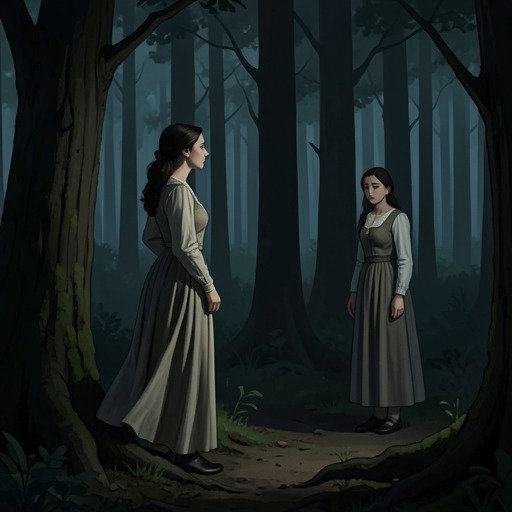
Lestat’s most intimate confrontation with the consequences of death comes when he encounters Patsy in the swamp. He perceives her as a drowned, lifeless figure tangled in moss and creeper vine, her hair and white gown soaked through, her appearance dimly luminous in a way mortal eyes cannot see. Quinn stands nearby, searching for her. The vision is not an abstract account of a soul but an encounter with a damaged, suffering person whom Lestat can see and address.
He urges Patsy toward the Light by speaking of what remains for her among the living. Quinn, who killed his mother, vows that he will give her songs life forever by gathering together the music she recorded. Lestat joins that promise to an appeal: her songs are a gift people love, something she can leave behind. The gesture does not erase Quinn’s act or Patsy’s suffering; it offers a form of remembrance while Lestat tries to help her depart.
Patsy can barely move or speak. She raises her hand slightly and parts her lips, and Lestat senses her inclination toward him. He crosses the perilous distance and kisses her. As he does, he feels a force rise from within him and pass into her, carrying her away until her form grows faint, immense, and brilliant. Mona cries out for Patsy to go into the Light. In that moment Lestat does not become the saint he imagined: he acts with tenderness and risk, using a power whose experience frightens him and whose limits he cannot fully explain.
Afterward, Lestat says that he and Patsy seemed connected as she began to rise, and that some force may have tried to take him with her. He does not claim certainty about what happened. He admits that he sometimes sees angels, finds the experience frightening, and does not want to relive it; what matters to him is that Patsy is gone on. Quinn says he saw the Light but did not see Patsy’s spirit, while the banshee recalls Lestat fighting with someone, cursing in French, and crying out about Oncle Julien. These differing perceptions preserve the event’s uncertainty rather than turning Lestat’s act into a fully explained miracle.
Narrative Role and Significance
Lestat’s narration makes self-invention visible. He stages a grand arrival as a saint, then exposes the scene as a fantasy and admits that he is far from the Sistine Chapel. The reversal does not simply mock religious longing. It shows how a desire for public sanctity can coexist with a private, painful knowledge of one’s failures—and how that desire may still orient a person toward acts of care.
The story repeatedly distinguishes recognition from responsibility. Canonization gives Juan Diego a place in the Church’s public memory, while Lestat’s imagined sainthood remains an invention. But Lestat’s reflection on Juan Diego turns his envy outward, toward the petitions and suffering a saint might attend to. His own acts cannot secure that public status. He can reassure Jasmine, acknowledge the limits of absolution, and try to lead Patsy toward the Light; he cannot make those deeds proof that he is pure.
That unresolved distinction is the defining feature of Lestat’s trajectory in these passages. He rejects the fantasy that he has been officially made a saint, yet he continues to act in a world where the dead and the vulnerable need help. His longing for goodness is therefore neither a solved conversion nor a mere vanity. It is a demand he makes of himself, repeatedly contradicted by his nature and repeatedly renewed through what he chooses to do.